

Baby clothing sizes are one of the most confusing parts of shopping for a new baby. Every brand sizes differently. "Newborn" at one store fits a 6-pound baby; at another it fits a 10-pound baby. "3-6 months" can mean anything from 12 to 17 pounds depending on who made the label. And babies grow at wildly different rates, so age-based sizing is really just a starting point.
Here's how to navigate baby clothing sizes with confidence — so you stop guessing, stop over-buying the wrong sizes, and start getting real wear out of everything you purchase.
Why Baby Sizing Is So Confusing (And Why Age Labels Are Misleading)
The root of the confusion: there is no industry standard for baby clothing sizes in the US. Each brand uses its own measurements, which means a "6M" at one brand and a "6M" at another can fit babies of very different sizes.
Age-based labels ("0-3M," "6-9M") are particularly unreliable because:
- Babies grow at very different rates — some 4-month-olds wear 9-month sizes
- Labels account for average growth but not the variance in individual babies
- Height and weight don't always scale together — a long, lean baby might need a different size than a shorter, chunkier one of the same age
The solution: always shop by weight and height, not age. Every quality baby brand includes a weight range on their size chart. Use it.
Standard US Baby Clothing Sizes: A Reference Guide
While brands vary, here are the general US market conventions as a starting point:
- Preemie (P): Under 5 lbs / under 17 inches
- Newborn (NB): 5–8 lbs / 17–21 inches
- 0–3M: 8–12 lbs / 21–24 inches
- 3–6M: 12–16 lbs / 24–26.5 inches
- 6–9M: 16–20 lbs / 26.5–28.5 inches
- 9–12M: 20–23 lbs / 28.5–30.5 inches
- 12–18M: 23–27 lbs / 30.5–32 inches
- 18–24M: 27–30 lbs / 32–34 inches
- 2T: 27–32 lbs / 33–36 inches
- 3T: 30–36 lbs / 36–39 inches
Remember: these are starting points, not guarantees. Check the specific brand's size chart every time.
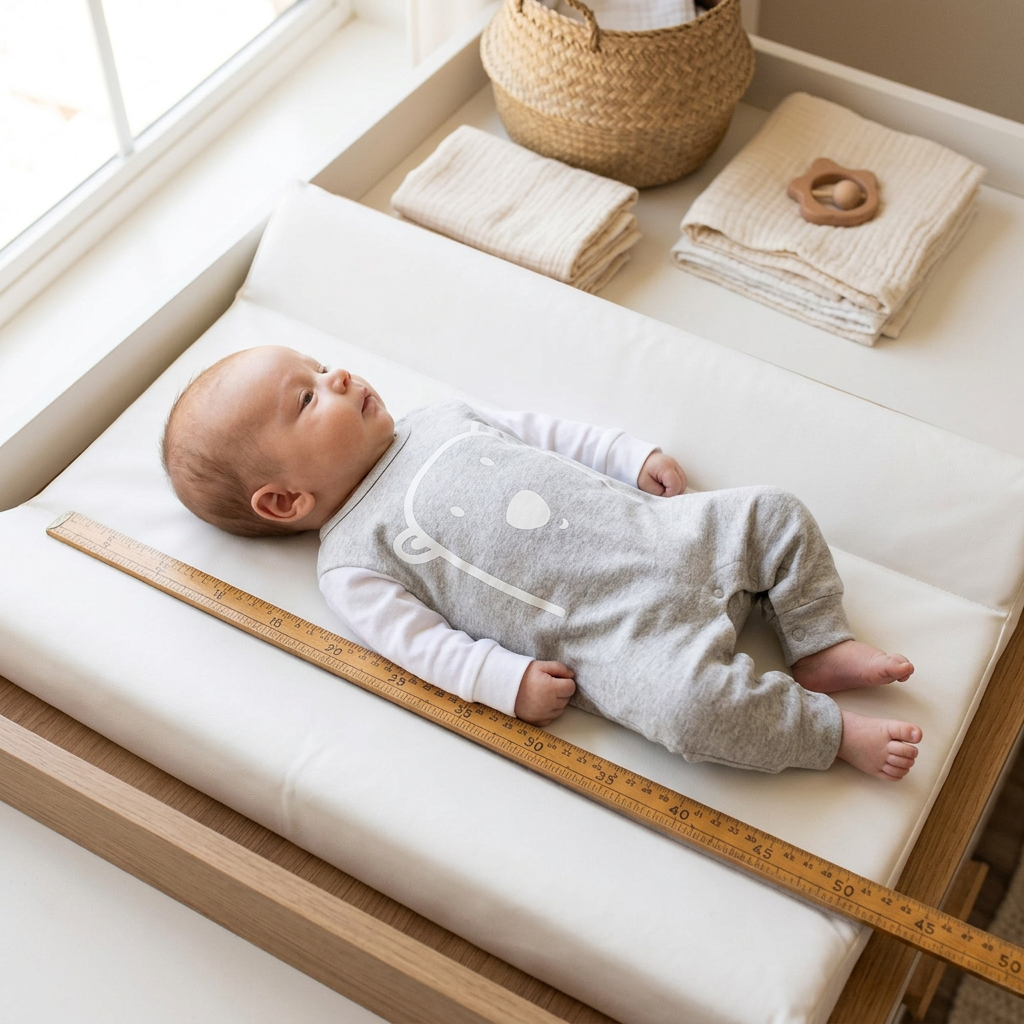
How to Measure Your Baby for Clothing
You don't need a tailor — just a soft measuring tape and a cooperative baby (or a sleeping one).
- Weight: The most reliable single measurement for sizing. Use your baby's most recent pediatrician weight or a home scale.
- Height/Length: Measure from crown of head to heel with baby lying flat and fully extended. This matters most for sleepers and footie pajamas where overall length is the constraint.
- Chest: Measure around the widest part of the chest. Important for jackets and structured tops.
- Head circumference: For hats and hooded items. Measure around the widest part of the head just above the eyebrows.
Should You Size Up?
In most cases, yes — especially for gifts and for items you're buying ahead of time. Here's the thinking:
- Babies grow into larger sizes much faster than parents expect
- A slightly large piece will fit soon; a too-small piece is already done before it's been worn
- Organic cotton and knit fabrics have some natural stretch that accommodates a size up without looking sloppy
- The exception: sleepwear. By US regulations, baby sleepwear must be either snug-fitting or flame-resistant. Sizing up on sleepers can compromise the snug fit requirement — follow the size chart exactly for sleep items.
How Different Garment Types Fit
Even within the same brand, different garment types size differently:
- Bodysuits: Size by weight primarily. The snap crotch gives some length flexibility. Most forgiving garment for sizing.
- Rompers and one-pieces: Size by both weight AND height. A long baby will outgrow the length before the width. Go up if your baby is on the taller end.
- Pants and shorts: Size primarily by waist and hip. Weight is your best guide.
- Dresses: More forgiving than one-pieces since there's no leg length constraint. Usually size by weight.
- Footie pajamas/sleepers: Most size-sensitive item. Height matters most — if baby is too long, their legs will be bent uncomfortably. Go up a size the moment there's any tension at the feet.
- Jackets and outerwear: Size up one to allow layering underneath.
Signs a Garment Is the Wrong Size
Too small:
- Snaps pulling or gaping at the crotch
- Red marks on skin from elastic, cuffs, or necklines
- Legs or arms visibly short on the garment
- Difficulty snapping closed without pulling the fabric
Too large:
- Neckline slipping over baby's face
- Sleeves covering hands significantly (some overlap is normal for warmth)
- Legs bunching more than a small amount at the feet
- Excess fabric bunching under the car seat harness (safety concern)
Buying for a Baby You Haven't Met Yet
If you're buying as a gift or stocking up before birth:
- Avoid newborn size unless you know the baby will be small: Average US babies (7.5 lbs) may wear NB for only 1–2 weeks. 0–3M is almost always the safer bet.
- 0–3M and 3–6M are the most useful gift sizes: They're worn the longest and need the most replenishment.
- Buy for the season they'll actually be wearing it: A baby born in October who receives 3M size clothes will be wearing them in January. Buy for winter, not fall.
- When in doubt, go up: No parent has ever been disappointed by a gift that's "a little big right now."
Shop Mimou Babywear with Confidence
Every Mimou garment includes a clear weight and height range on the size chart — because we know age labels alone don't tell you enough. Our pieces are cut with generous sizing that gives real growing room without looking oversized, so you get more wear out of every size before moving up.
Browse the full collection, check the size chart for your baby's current measurements, and shop with confidence.