


Here's something that surprises a lot of parents: there is no single "correct" way to crawl, and a meaningful number of babies skip crawling on hands and knees entirely — shuffling on their bottoms, slithering on their bellies, rolling, or going straight to pulling up and cruising before they ever do the classic crawl. The textbook hands-and-knees crawl is common, but it was never a required milestone. In fact, since the American Academy of Pediatrics removed crawling from its official milestone checklists, it's officially recognised as a variable skill rather than a universal one. So if your baby is doing something that doesn't look like the crawling in the books — that's usually completely normal. Here's what's actually going on, and how to help.
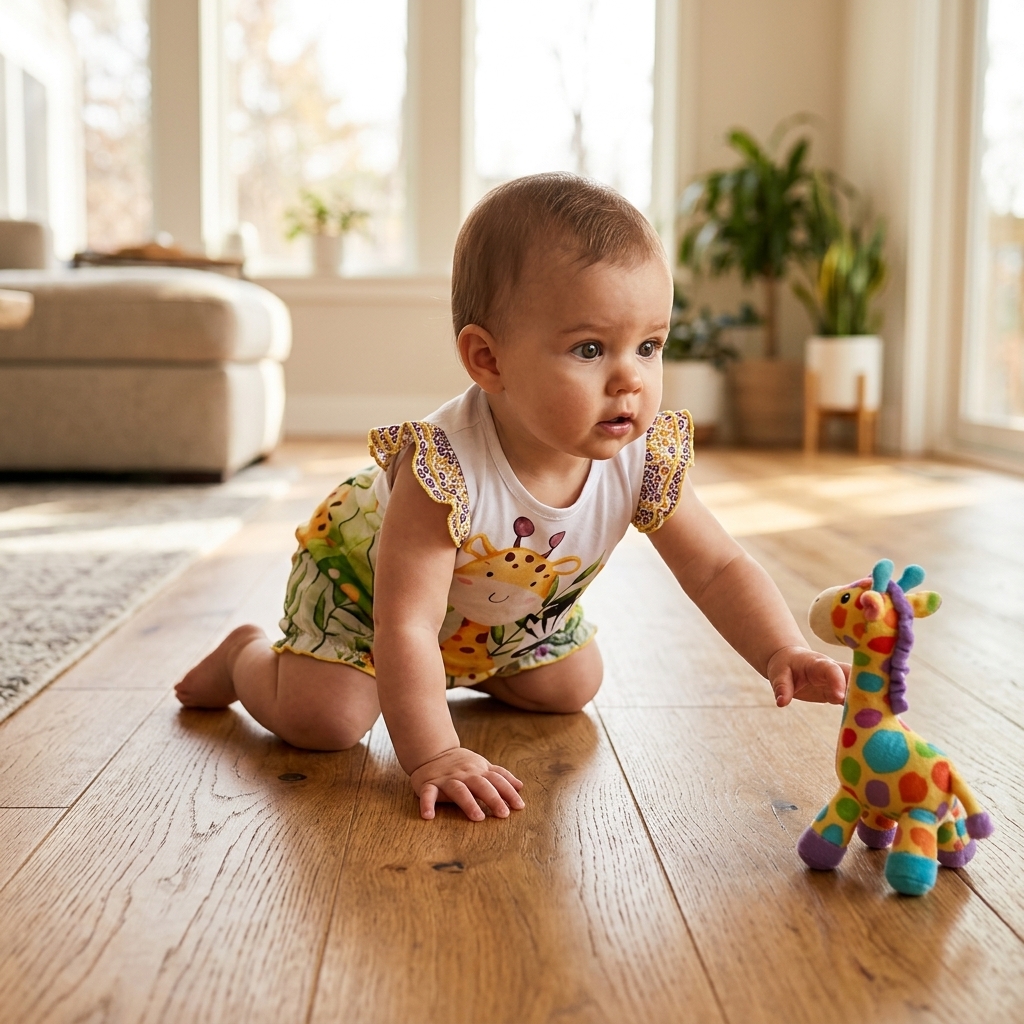
When Do Babies Start Crawling?
Most babies who do crawl begin somewhere between 6 and 10 months, with many finding their method around 8–9 months. But the range of normal is wide, and the timing depends heavily on opportunity (how much floor and tummy time a baby gets), temperament, and body type. A baby who spends more time on the floor, free to move, generally gets mobile sooner than one who spends a lot of time in seats, bouncers, and carriers.
The Stages That Lead to Crawling
Crawling doesn't appear from nowhere — it's the product of months of strength-building. The typical progression:
- Tummy time foundations (0–4 months): Every minute of tummy time builds the neck, shoulder, arm, and back strength crawling requires. This is the groundwork. Our tummy time guide covers how to build it from birth.
- Pivoting and rolling (4–6 months): Baby starts pushing up on the arms, pivoting in circles on their tummy, and rolling to get to things. The first taste of self-directed movement.
- The "commando" or army crawl (6–8 months): Many babies start by dragging themselves forward on their belly using their arms, legs trailing. A completely legitimate form of crawling and often the first effective one.
- Rocking on hands and knees (7–9 months): Baby pushes up onto all fours and rocks back and forth — building the strength and coordination for the real thing. The rocking is the rehearsal.
- Coordinated crawling (8–10 months): The cross-pattern hands-and-knees crawl, where opposite hand and knee move together. Or, just as validly, a bottom-shuffle, a crab-crawl, or a roll-and-go.
How to Encourage Crawling
You can't (and shouldn't try to) force crawling, but you can create the conditions that invite it:
- Maximise floor time: This is the single biggest lever. A baby needs unrestricted floor space to practice. Time spent in bouncers, walkers, and seats is time not spent building crawling strength. Lay them down and let them work.
- Keep up the tummy time: Even once baby is sitting, tummy time continues to build the exact muscles crawling needs.
- Place toys just out of reach: Motivation drives crawling. A favourite toy placed slightly beyond their grasp gives a reason to figure out forward motion. Don't make it frustratingly far — just enough to inspire effort.
- Get down on the floor with them: Crawl alongside them, model the movement, make it a game. Babies are powerful imitators.
- Create safe inclines and obstacles: A cushion to crawl over, a tunnel to go through, a low pillow course — gentle challenges build strength and problem-solving.
- Dress for movement: Bulky, stiff, or slippery clothing genuinely impedes a new crawler. Fitted, flexible cotton that lets knees grip and limbs move freely makes a real difference — and bare or grippy-soled feet help far more than slick socks on hard floors.
Crawling and Safety: The Two Go Together
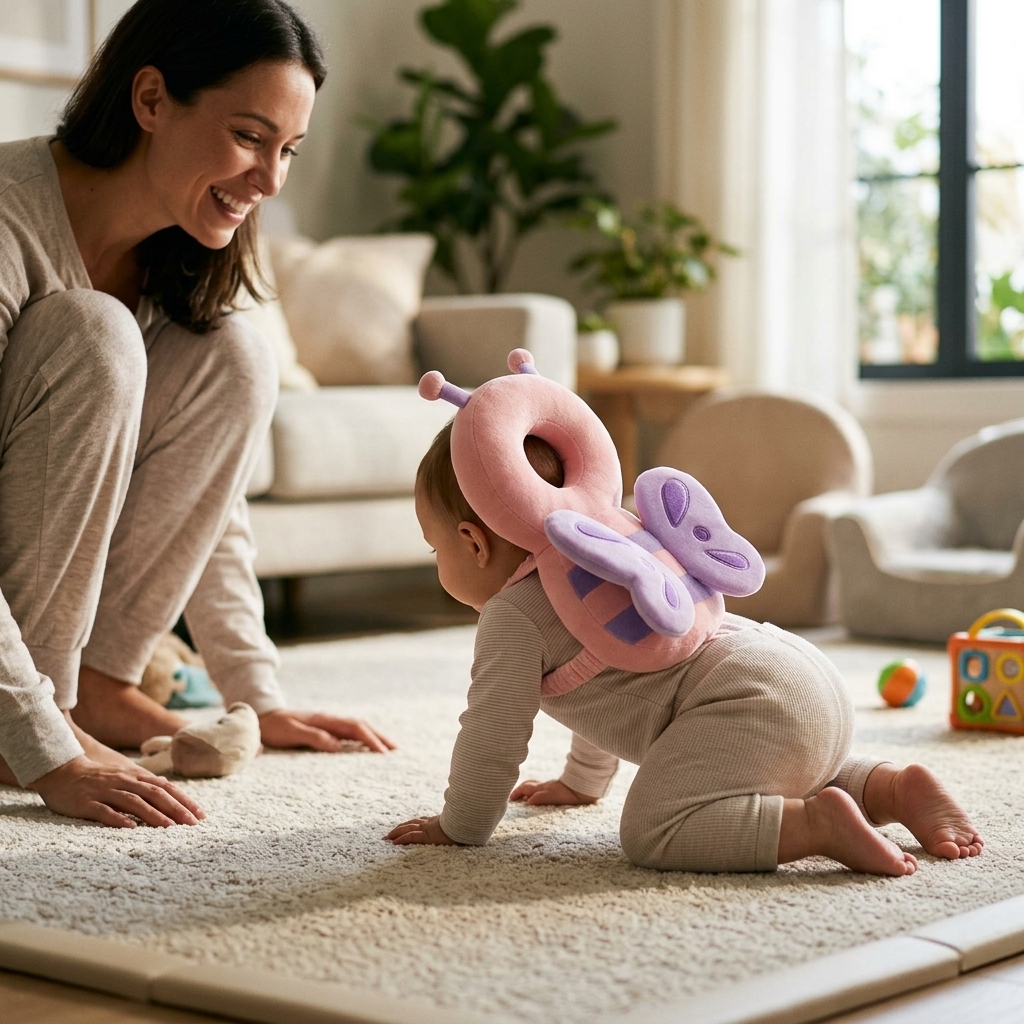
The day crawling begins is the day your home changes. A newly mobile baby can reach hazards that were irrelevant a week earlier — stairs, cords, low cabinets, small objects on the floor. If you haven't already, now is the moment to baby-proof properly; our room-by-room babyproofing checklist walks through it. For new crawlers and cruisers who take a lot of tumbles, some parents use a soft padded head-protection cushion as an extra layer of reassurance on hard floors — a small comfort during the wobbliest weeks, though nothing replaces supervision and a properly secured space.
When to Mention It to Your Doctor
Because crawling is so variable, its absence alone isn't usually a concern — especially if your baby is getting around some other way and meeting other milestones. That said, mention it to your pediatrician if, by around 9–12 months, your baby: isn't attempting to move or get around by any method at all; can't bear weight on their legs or push up on their arms; uses only one side of their body to move (consistent asymmetry is worth checking); or has lost skills they previously had. These are worth a professional look — not because they definitely indicate a problem, but because early assessment is always the right call when something seems off.
For most babies, though, crawling — in whatever idiosyncratic form it takes — arrives in its own time, and is quickly followed by the next adventure. See our guides on when babies start walking and first walker shoes for what comes next.