


Crawling is one of the most eagerly anticipated milestones of the first year — the moment a baby transforms from a stationary observer of the world into an active explorer of it. But it's also one of the most variable milestones developmentally, with a wide normal range and multiple valid crawling styles. Here's the complete picture: when crawling happens, what precedes it, the different ways babies crawl, and how to encourage it safely.
When Do Babies Start Crawling?
Most babies begin some form of crawling between 7 and 10 months. The average is around 8–9 months, but the normal range extends from as early as 6 months to as late as 12 months. Some babies skip crawling entirely and move straight from sitting to pulling up and walking — this is a recognized developmental variation, not a delay.
The timing of crawling is influenced by several factors:
- Tummy time exposure: Babies who have more supervised tummy time typically develop the core and upper body strength needed for crawling earlier. See our guide on when babies hold their head up for the full tummy time framework.
- Body type and temperament: Larger babies may take slightly longer to develop the strength-to-weight ratio needed for crawling. Cautious babies may take longer to attempt movement even when physically capable.
- Surface: Carpeted floors provide more grip and are easier for early crawling attempts than smooth hardwood or tile.
- Motivation: A toy or person just out of reach is a more effective crawling motivator than an empty floor.
The Motor Skills That Precede Crawling
Crawling doesn't appear out of nowhere. It's the result of several months of progressive motor development:
| Skill | Typical Age | Why It Matters for Crawling |
|---|---|---|
| Head control | 3–4 months | Foundation for all subsequent motor development |
| Rolling | 4–6 months | Develops trunk rotation and weight shifting |
| Sitting with support | 4–6 months | Builds core stability needed to hold crawling position |
| Sitting independently | 6–8 months | Strong core and balance needed for four-point position |
| Rocking on hands and knees | 6–8 months | Direct precursor — baby in crawling position learning weight shift |
The Different Ways Babies Crawl
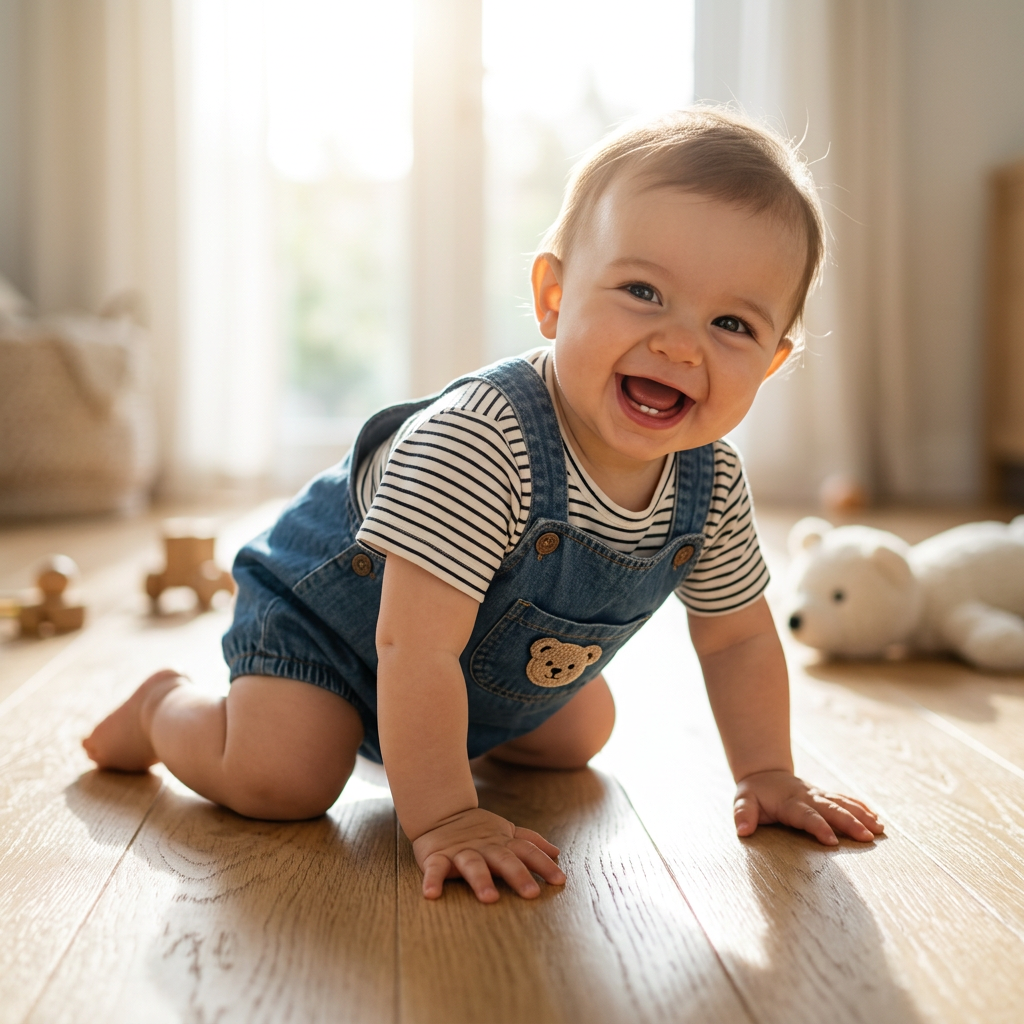
Classic hands-and-knees crawling is the most common, but it's far from the only valid style. All of the following are recognized forms of locomotion that count as crawling developmentally:
- Classic crawling (cross-lateral): Opposite hand and knee move together — right hand, left knee, then left hand, right knee. The most common and most efficient form.
- Commando/belly crawling: Baby pulls forward on forearms with the belly on the floor. Often appears before hands-and-knees crawling. A normal precursor, not a delay.
- Bottom shuffling: Baby sits upright and uses hands to push and shuffle forward on their bottom. Common in babies with good sitting balance who are less motivated by tummy time. Linked to later walking — these babies often don't walk until 14–16 months, which is still normal.
- Bear crawling: Hands and feet flat on the floor, knees not touching the ground. Normal variation.
- Crab crawling: Moving sideways or backward. Often an early form that evolves into forward crawling as control improves.
Why Crawling Matters
Beyond the obvious functional benefit of mobility, crawling does important developmental work across multiple systems:
- Bilateral coordination: Cross-lateral crawling requires the left and right hemispheres of the brain to coordinate — a pattern that shows up later in reading, writing, and sports.
- Core and upper body strength: The demands of crawling build the foundational strength for sitting tall, standing, and eventually walking.
- Depth perception: Crawling across different surfaces and toward and away from objects develops the visual-spatial processing that underlies depth perception.
- Proprioception: The sensory feedback from weight-bearing on hands and knees builds body awareness and postural control.
- Independence and confidence: The ability to move toward desired objects and people, and away from undesired ones, is a significant psychological milestone as much as a physical one.
How to Encourage Crawling
- Maximize floor time: A safe, clear floor area is the most important prerequisite. Bouncy seats and swings are comfortable but don't develop the muscles needed for crawling.
- Tummy time from birth: The single most evidence-supported way to develop the upper body and core strength that crawling requires.
- Place interesting objects just out of reach: A toy 20–30cm in front of baby provides the motivation to attempt forward movement.
- Get on the floor with baby: Your presence at floor level is more motivating than any toy.
- Use a mirror: A baby-safe mirror at floor level gives baby a reason to move toward it.
- Try a rolled towel under the hips: For babies struggling to get off their belly, a rolled towel under the hips slightly elevates them into a better starting position.
Safety When Crawling Begins
Crawling changes the safety requirements of your home immediately and dramatically. Before or as soon as crawling begins:
- Install safety gates at the top and bottom of all staircases
- Secure heavy furniture (bookshelves, dressers) to walls — pulling to stand follows crawling quickly
- Cover electrical outlets and manage all loose cords
- Get down to floor level and do a room-by-room visual check from baby's eye level
- Remove any small objects from the floor (choking hazard) and any plants within reach (many are toxic)
What to Dress a Crawling Baby In
Crawling creates specific clothing requirements that sitting babies don't have. The key considerations:
- Knee protection: Long trousers or knee patches protect skin on hard floors. Denim and thicker cotton wear better than lightweight fabrics.
- No restrictive waistbands: Tight waistbands limit the hip and knee flexion needed for crawling. Soft elastic or adjustable waistbands work best.
- Non-slip feet: If dressing in a sleeper or footed garment, non-slip soles are important on smooth floors. Bare feet actually provide the best grip on most surfaces.
- Freedom of movement: Any garment that restricts shoulder or hip movement will frustrate a crawling baby. Stretchy fabrics and relaxed fits are ideal.
For the full picture of what to dress baby in at each stage, see our milestone dressing guide and our complete milestones by week guide.
When to Speak to a Pediatrician
Mention to your pediatrician if, by 12 months, baby shows no form of independent mobility — no crawling, no bottom shuffling, no pulling to stand. A baby who was mobile and loses that ability also warrants prompt evaluation. Most well-child visits include a developmental screening; use it actively to ask any questions about motor development you've been collecting.