


It's one of the first questions parents of a premature baby ask once they're home: when will my baby actually fit newborn clothes? The preemie pile is dwindling, someone's given you a drawer full of 0–3 month outfits, and your baby is still swimming in them. The honest answer depends less on the calendar than on weight — and on a concept the hospital may have mentioned once and never explained properly: corrected age. Here's how preemie sizing actually works, and how to know when your baby is ready for the next size.
Corrected Age: The Concept That Explains Everything
Corrected age (also called adjusted age) is your baby's age counted from their due date, not their birth date. A baby born eight weeks early who is twelve weeks old has a corrected age of four weeks.
This matters for clothing because baby sizes are built around a full-term baby's growth curve. A premature baby follows that same curve — just starting later. So your baby will generally fit the size a full-term baby wears at their corrected age, not their actual age. Once you understand this, the drawer full of "wrong" sizes suddenly makes sense: they're not wrong, they're just early.
Weight Is the Real Answer
Ages on labels are a rough guide; weight is what actually determines fit, especially in the smallest sizes. As a general framework:
- Micro preemie sizes: roughly under 3–5 lb (1.4–2.3 kg)
- Preemie: roughly 5–6 lb (2.3–2.7 kg)
- Newborn: roughly 6–9 lb (2.7–4.1 kg)
- 0–3 months: roughly 9–12 lb (4.1–5.4 kg)
So the practical answer to "when will my preemie fit newborn?" is: when they reach roughly 6 lb / 2.7 kg — whenever that happens, whatever the calendar says. For a baby born at 32 weeks, that's often somewhere around their original due date, but it varies enormously, and it should. (Our preemie clothing size chart has the full weight-to-size breakdown.)
Why Two Preemies the Same Age Wear Different Sizes
Premature babies grow at very different rates depending on how early they arrived, their birth weight, and their medical history. A baby born at 34 weeks and one born at 27 weeks are on completely different timelines, even if they're the same age today. This is why comparing your baby to another — or to a chart's age column — causes needless worry. Go by weight and by how clothes actually fit. Your baby's growth is being tracked by professionals who will tell you if there's a concern; the clothing size is just clothing.
How to Tell the Size Actually Fits
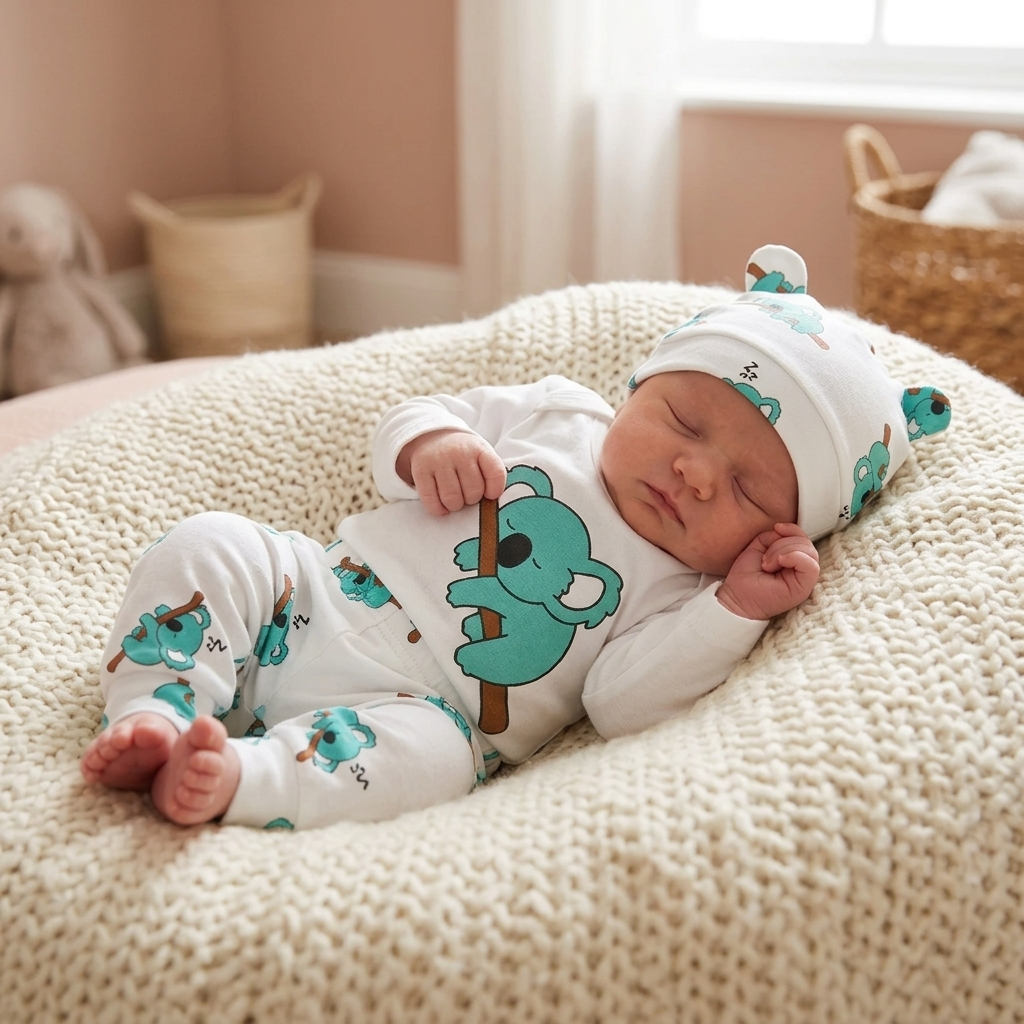
Forget the label for a moment and check the garment:
- Shoulders and neckline: If the neckline gapes and the shoulders slip, it's too big — the most reliable single check.
- Crotch poppers: Should fasten without pulling. If there's a large fabric bunch, size down; if it's straining, size up.
- Sleeves and legs: A little length to grow into is fine (cuffs can be rolled); a lot means the whole garment is swamping them.
- Movement: Your baby should be able to kick and stretch freely. Too-big clothes bunch and restrict as much as too-small ones.
An outfit that's slightly big is fine and normal. An outfit your baby disappears into isn't doing them any favours — and, for very small babies, excess loose fabric around the face and neck is worth avoiding.
The Awkward In-Between Stage
Most parents hit a gap where preemie is getting snug but newborn is still enormous. A few things that help:
- Don't rush the next size. A snug preemie piece that still fastens is more comfortable than a newborn one that swamps them.
- Look for adjustable, forgiving cuts. Rompers with plenty of snaps, envelope necklines, and roll-back cuffs bridge sizes far better than fitted pieces.
- Buy small quantities. This stage passes quickly — a handful of pieces in the current size beats a full wardrobe you'll outgrow in a fortnight.
- Prioritise easy-open designs. Front-opening, snap-fastened clothes that lay flat are far kinder for small babies who may still have monitoring or feeding equipment, and gentler for you (see our guide to dressing a premature baby).
Will They Catch Up?
Most premature babies do catch up on growth over the first two years, which is why paediatricians typically use corrected age until around age two. Practically, this means the size gap narrows over time: the difference between actual and corrected age matters enormously at three months and hardly at all by two years. Many parents find their baby is wearing "age-appropriate" sizes long before they expected — and stop thinking about it entirely.
The Bottom Line
Your premature baby will fit newborn clothes when they reach roughly 6 lb / 2.7 kg — not on a particular date. Use corrected age to set expectations, use weight to choose the size, and use the fit of the actual garment as the final word. Buy small quantities in each size, favour soft, snap-fastened, easy-open pieces, and don't compare your baby's timeline to anyone else's. The in-between stage is short, even when it doesn't feel like it.
See our full preemie clothing size chart for weight-to-size guidance, and browse soft, easy-open pieces in our collections. This article is general information, not medical advice — your baby's medical team is the right source for guidance on their growth.