


The number that appears on a newborn's first weigh-in is one of the most recorded facts in any baby's early life — shared in birth announcements, compared with other babies, and referenced at every pediatric visit for years. But what does "average newborn weight" actually mean, what factors shape it, and when does a weight measurement actually indicate something worth investigating? Here's the complete picture.
What Is the Average Newborn Weight?
The average birth weight for a full-term newborn (37–42 weeks) in the United States is 7 lbs 11 oz (3.5 kg). The typical range for healthy full-term babies spans roughly:
- 5 lbs 8 oz to 10 lbs (2.5–4.5 kg): The broad range that encompasses the vast majority of healthy births
- Low birth weight: Below 5 lbs 8 oz (2.5 kg) — requires additional monitoring and sometimes NICU care
- Very low birth weight: Below 3 lbs 5 oz (1.5 kg)
- Macrosomia (large for gestational age): Above 8 lbs 13 oz (4 kg) at term
These numbers apply to singleton pregnancies. Twins and higher-order multiples have different weight expectations based on gestational age and the dynamics of sharing a uterus.
Average Newborn Weight by Gender
| Gender | Average Birth Weight | Typical Range |
|---|---|---|
| Male | 7 lbs 12 oz (3.53 kg) | 5 lbs 9 oz – 10 lbs 2 oz |
| Female | 7 lbs 9 oz (3.44 kg) | 5 lbs 7 oz – 9 lbs 13 oz |
The difference is real but modest — baby boys average slightly heavier than girls from birth, a difference that persists and widens slightly through early childhood.
What Determines Birth Weight?
Birth weight is shaped by multiple intersecting factors, most of which are outside anyone's control:
- Gestational age: The most dominant factor. Every week of gestation adds meaningful weight — a baby born at 37 weeks weighs significantly less on average than one born at 40 weeks.
- Genetics: Parents' own birth weights and sizes are among the strongest predictors of a baby's birth weight.
- Birth order: Second and subsequent babies tend to be heavier than first babies.
- Maternal nutrition and weight: Pre-pregnancy weight, gestational weight gain, and nutritional status all influence fetal growth.
- Maternal health conditions: Gestational diabetes is associated with larger babies (macrosomia); hypertension and some other conditions with smaller ones.
- Placental function: The placenta is the fetus's sole source of nutrition. Placental insufficiency reduces fetal growth.
- Race and ethnicity: Average birth weights vary across ethnic groups, primarily reflecting genetic and socioeconomic factors.
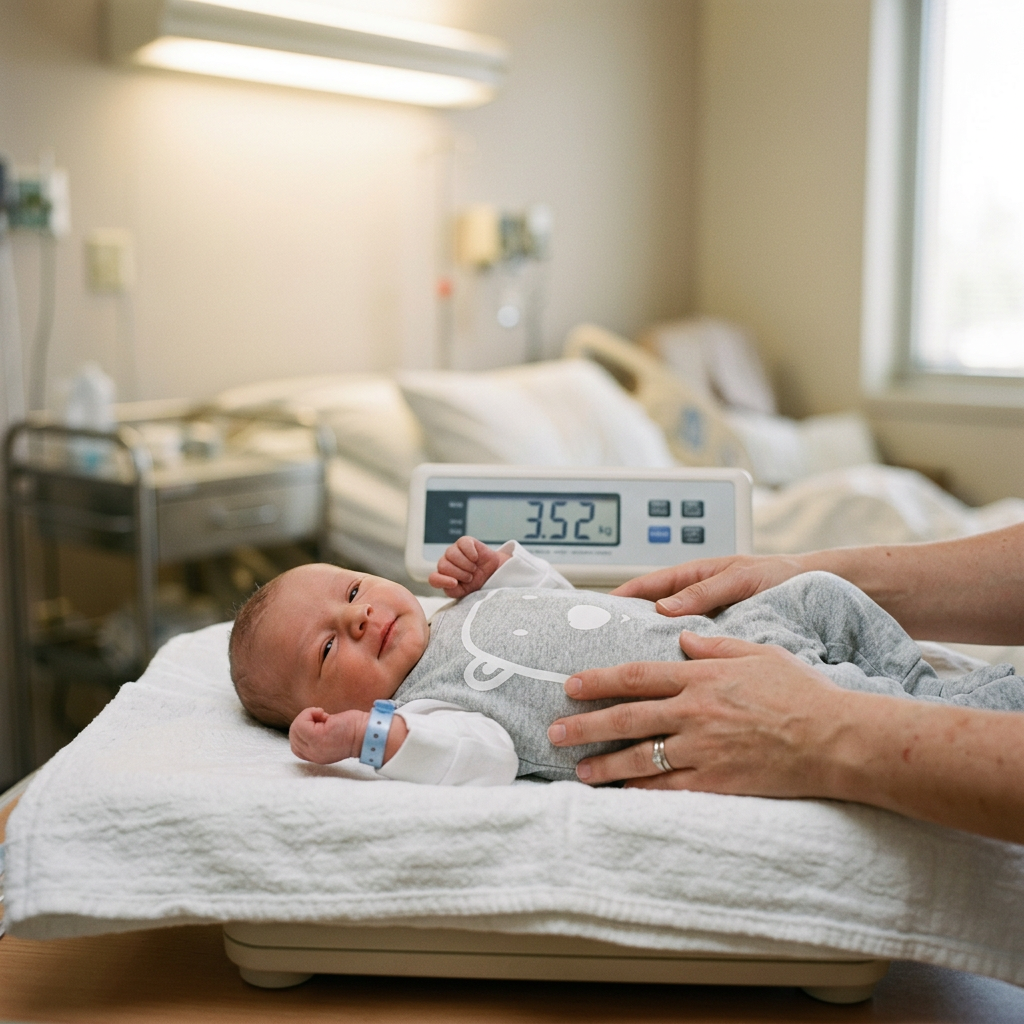
The Initial Weight Drop: Why Babies Lose Weight After Birth
Almost all newborns lose weight in the first 3–5 days of life. This is normal, expected, and not a sign of a feeding problem in most cases. The weight comes from:
- Loss of meconium (first stool)
- Loss of excess fluid retained during gestation
- The transition to milk feeding, during which intake is still establishing
The guidelines:
- Up to 7% weight loss: Normal for breastfed babies; acceptable for formula-fed
- Up to 10% weight loss: Within normal range but warrants close monitoring and lactation support for breastfed babies
- More than 10% weight loss: Warrants investigation and often intervention to improve feeding
- Return to birth weight by 10–14 days: The standard benchmark. Most healthy babies achieve this; delayed regain warrants a feeding assessment.
Baby Weight Gain After Birth: What to Expect
| Age | Typical Weight Gain |
|---|---|
| Birth to 3 months | ~1 oz (28g) per day; ~5–7 oz per week |
| 3–6 months | ~0.5 oz (14g) per day; ~3.5–5 oz per week |
| 6–12 months | ~3–4 oz per week |
| 1–3 years | ~4–6 lbs per year |
Most babies double their birth weight by 4–5 months and triple it by their first birthday. These are averages — individual trajectories vary, and the direction of travel on the growth curve matters more than any single measurement.
Understanding Percentiles
A percentile tells you where a baby falls relative to other babies of the same age and sex. A baby in the 25th percentile is not underweight — they weigh more than 25% of babies their age and less than 75%. Any percentile from the 3rd to the 97th is within the normal range.
What matters more than the percentile itself is consistency. A baby who tracks steadily at the 10th percentile is growing appropriately. A baby who drops from the 60th percentile to the 20th over two visits is showing a pattern that warrants investigation, regardless of the absolute number.
For the clothing sizing context that goes alongside growth tracking, see our newborn clothes size chart and our baby clothing size guide. For the developmental picture alongside growth, see our baby milestones by week guide.