


Swaddling is one of the oldest and most consistently effective newborn care techniques. Done correctly, it mimics the snug containment of the womb, calms the startle reflex that wakes many newborns, and extends sleep. Done incorrectly, it creates safety risks. Here's the complete guide — the right technique, the right materials, the safety rules, and when to stop.
Why Swaddling Works
Swaddling works for three interconnected reasons:
- It dampens the Moro reflex: The Moro (startle) reflex causes a sleeping newborn's arms to fling outward involuntarily in response to any change in stimulation. This reflex, which is entirely normal, wakes babies repeatedly. A swaddle keeps the arms contained, preventing self-startling.
- It recreates womb conditions: The uterus is warm, snug, and constantly in contact with the baby's skin. The relative openness of the outside world is genuinely overwhelming for newborns. A tight swaddle approximates the sensory experience they've had for 9 months.
- It regulates body temperature: A well-chosen swaddle blanket provides a consistent, controlled layer of warmth that newborns — who can't yet shiver effectively — cannot generate reliably on their own.
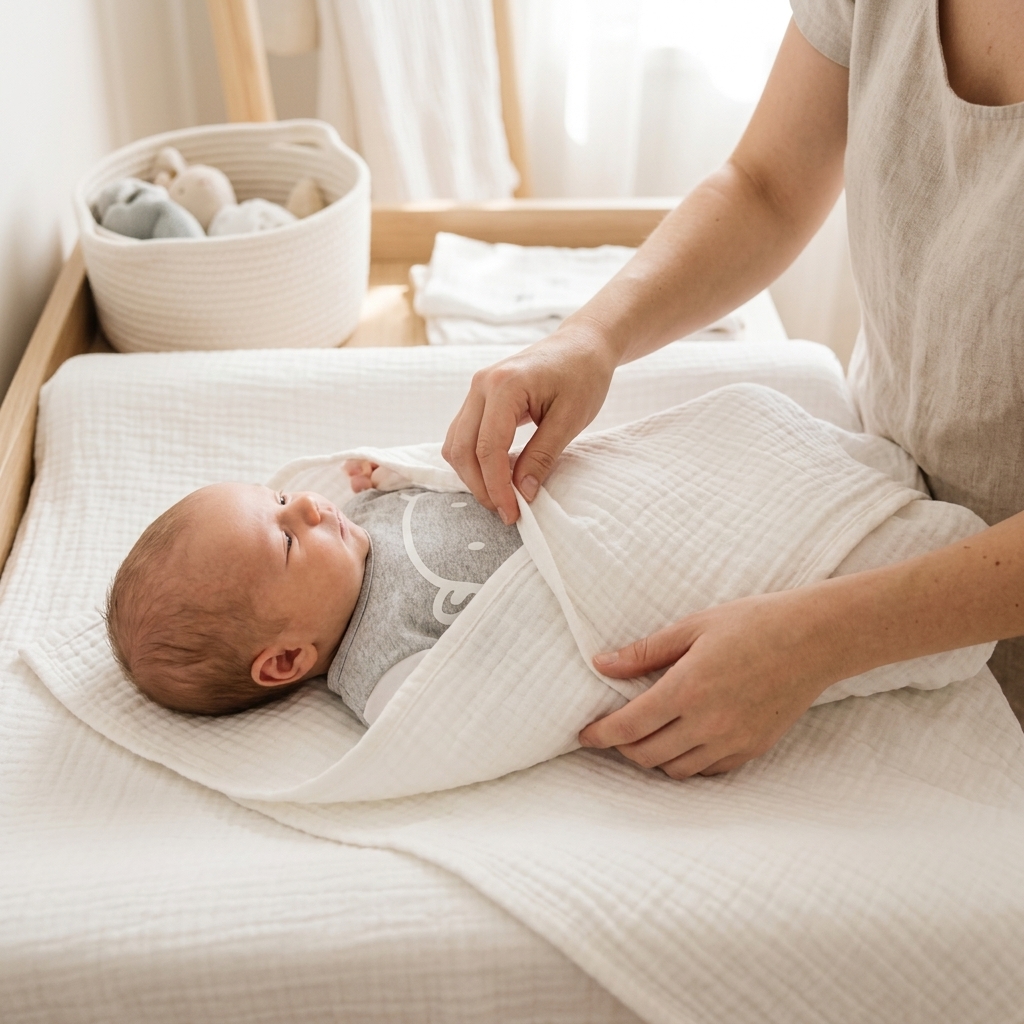
How to Swaddle a Baby: Step-by-Step
The classic "diamond swaddle" technique works with any large square muslin or cotton blanket:
- Lay the blanket in a diamond orientation on a flat surface. Fold the top corner down about 6 inches to create a flat edge at the top.
- Place baby face-up with their shoulders just below the folded edge. Baby's head rests above the blanket, never covered.
- Straighten baby's left arm alongside their body. Pull the left side of the blanket snugly across baby's chest and tuck it firmly under their right side.
- Fold the bottom corner up over baby's feet and tuck it behind the left shoulder, ensuring there's room at the bottom for the legs to flex naturally.
- Straighten baby's right arm. Pull the right side of the blanket across baby's chest and tuck the remaining fabric behind their back.
The finished swaddle should be snug at the chest and arms, with enough room at the bottom for the hips and knees to flex. The "two-finger rule": you should be able to slip two fingers between the blanket and baby's chest. Tighter risks breathing restriction; looser defeats the purpose.
Swaddling Safety Rules
Swaddling has a strong evidence base for calming newborns — but the same evidence base includes serious safety guidelines that must be followed:
- Always place a swaddled baby on their back: This is non-negotiable. Swaddled babies placed on their stomachs have a significantly elevated risk of SIDS because they cannot push up or turn as freely if their airway becomes obstructed.
- Never cover the face or head: The blanket should sit at shoulder level or below, never near the face.
- Stop swaddling when baby shows signs of rolling: The moment baby begins to show rolling ability (typically 3–5 months), swaddling becomes a safety risk. A rolling baby who can't free their arms cannot recover if they roll to their stomach.
- The legs must be able to move: A swaddle that wraps the legs straight and tight is linked to hip dysplasia. The hips should always be able to flex and spread naturally. This is called a "hip-healthy" swaddle.
- Don't swaddle too warmly: Overheating is a SIDS risk factor. Use a single-layer muslin or lightweight cotton swaddle in a room at 68–72°F. No additional blankets over a swaddled baby.
What to Wear Under a Swaddle
The layer under the swaddle matters. A swaddle adds warmth, so the layer underneath should be lighter than you might otherwise choose:
- Warm room (70°F+): A single short-sleeve onesie or just a diaper
- Comfortable room (68–70°F): A long-sleeve bodysuit or a short-sleeve onesie
- Cooler room (65–68°F): A long-sleeve bodysuit or a lightweight sleeper
Organic cotton bodysuits are the ideal base layer under a swaddle — they regulate temperature, allow skin to breathe, and have no rough seams that press against baby during extended wear. See our complete onesie guide for what to look for.
Swaddle Blankets vs. Swaddle Sacks
| Type | Pros | Cons |
|---|---|---|
| Muslin/cotton blanket | Versatile, breathable, inexpensive; works as swaddle, stroller cover, nursing cover | Requires technique; can be unwrapped by active babies |
| Zip/velcro swaddle sack | Easy and fast; consistent tightness; harder to escape | Only works as a swaddle; limited lifespan |
| Arms-out sleep sack | Transition option; safe when rolling begins | Less effective for startle reflex suppression |
When to Stop Swaddling
Stop swaddling when baby shows any of the following signs, regardless of age:
- Consistently breaking out of the swaddle
- Attempting to roll during tummy time (see our guide on when babies hold their head up for the motor development context)
- Rolling from back to side during sleep
- Seeming frustrated or uncomfortable when swaddled
Most babies are ready to transition out of swaddling between 3 and 5 months. The transition to a sleep sack (arms free) is usually smoother than an abrupt stop. For the full sleep sack guide, see our complete sleep sack guide.