

Language development is one of the most remarkable things that happens in the first two years of life. A newborn who communicates only through crying becomes, within 18–24 months, a small person who uses hundreds of words to express needs, desires, observations, and opinions. The journey between those two points involves a precise sequence of milestones that give parents clear signals about how language is developing — and when to seek support if it isn't.
When Do Babies Start Talking?
The answer depends on what "talking" means. The progression from first sounds to actual words to two-word combinations spans 18 months or more and moves through distinct stages:
| Age | Communication Milestone | What to Look For |
|---|---|---|
| 0–2 months | Crying differentiation | Different cries for hunger, discomfort, tiredness |
| 2–3 months | Cooing | Soft vowel sounds ("ooh", "aah") in response to social interaction |
| 4–6 months | Babbling begins | Consonant-vowel combinations ("ba", "ma", "ga", "da") |
| 6–9 months | Canonical babbling | Reduplicated syllables ("bababa", "mamama", "dadada") |
| 9–12 months | Variegated babbling + gestures | Different syllables together; pointing, waving, raising arms |
| 10–14 months | First words | 1–3 words used consistently and meaningfully |
| 12–18 months | Vocabulary growth | 10–20 words by 18 months (expressive vocabulary) |
| 18–24 months | Vocabulary explosion + two-word phrases | 50+ words; combining two words ("more milk", "daddy go") |
| 24–36 months | Sentences | 3–4 word sentences; 75%+ understood by strangers by 36 months |
What Are "First Words" and When Do They Arrive?
A first word, in speech-language pathology terms, is a sound or short vocalization that a baby uses consistently and intentionally to refer to a specific person, object, or concept. "Mama" counts as a first word when baby uses it specifically to call a parent — not when they produce the sound randomly during babbling.
Most babies produce their first true words between 10 and 14 months. Common early words include: mama, dada, up, more, no, hi, bye, ball, dog, and the names of significant objects or people in their immediate environment.
Importantly, babies understand far more than they can say. Receptive language — understanding words — significantly precedes expressive language. A 10-month-old who says no words may understand 20–30 words perfectly well. This is normal.
The Science of Language Acquisition
Language development is driven by two intersecting systems:
Statistical Learning
Babies are extraordinarily sensitive to the statistical patterns in the language they hear. They track which sounds occur together, which word boundaries are likely, and which words co-occur with which situations — all without conscious effort. This is why consistent, repetitive, context-rich language exposure is more important than "teaching" vocabulary.
Social-Pragmatic Learning
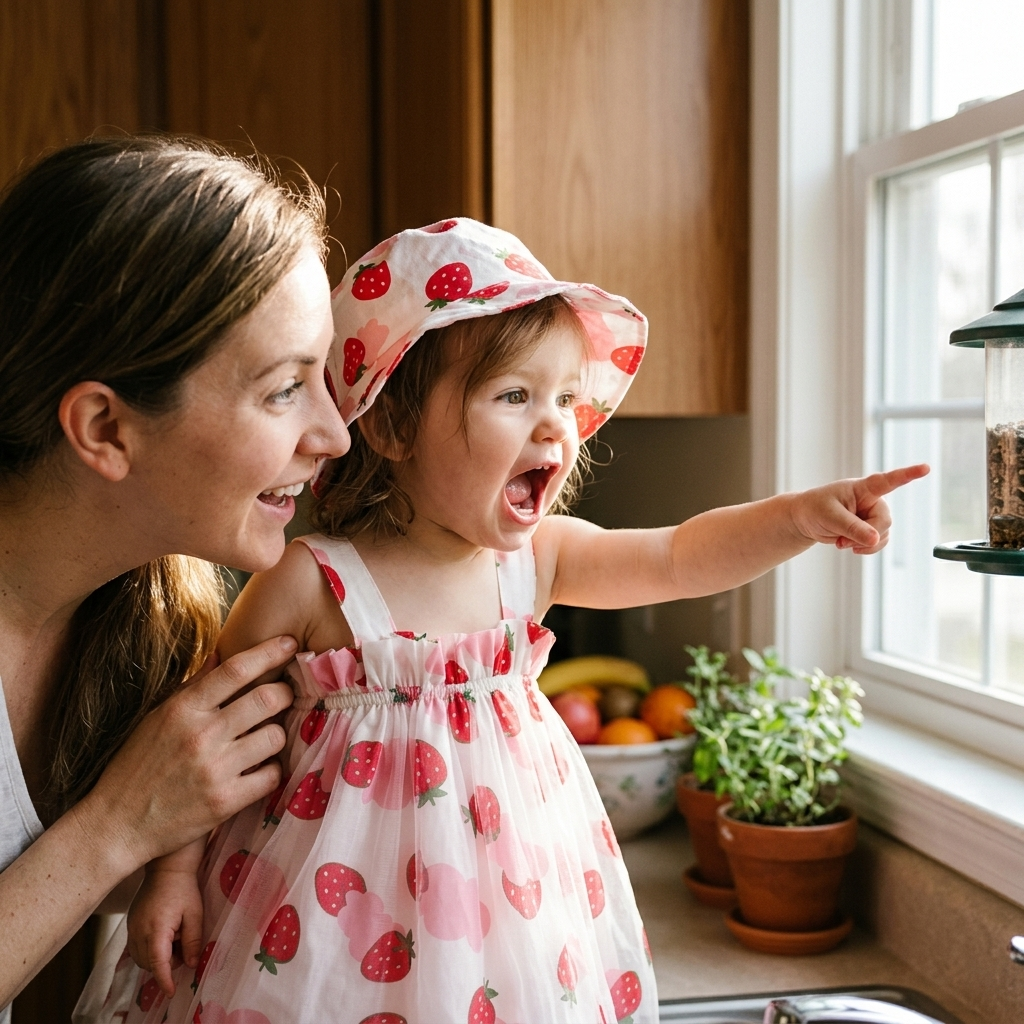
Babies learn language primarily through social interaction, not exposure alone. The critical ingredient is serve and return: a caregiver speaks to or looks at baby, baby responds (vocalizes, gestures, looks), caregiver responds to that response. Each complete serve-and-return exchange builds neural connections in the language centers of the brain. Passive exposure to language (TV, audio) is significantly less effective than live social interaction at the same language exposure level.
How to Support Language Development
- Talk constantly, from birth: Narrate your actions ("I'm putting on your blue socks now"), describe what baby sees ("There's a dog! A big brown dog!"), ask questions even before they can answer. The quantity of child-directed speech in the early years is one of the strongest predictors of language outcomes.
- Serve and return: When baby babbles, babble back. When they point, name what they're pointing at. When they vocalize, respond before speaking yourself. This turn-taking structure is the foundational practice of conversation.
- Read aloud daily: Books expose babies to vocabulary, sentence structures, and narrative patterns they don't encounter in everyday conversation. Even board books read to a 3-month-old build language-relevant neural architecture.
- Expand and extend: When baby says "dog", you say "yes, a big dog!" or "the dog is running!" You acknowledge and build on what they've said without correcting. This modeling is one of the most effective techniques for vocabulary growth.
- Limit background noise and screens during interaction time: Background television significantly reduces the quantity and quality of parent-child verbal interaction. Quiet focused interaction time is more valuable than passive background exposure.
- Sing: Songs provide repetitive, rhythmically organized language that is particularly effective for young language learners. Nursery rhymes and simple songs with repeated phrases build phonological awareness.
Bilingual Families
Bilingual babies typically begin speaking slightly later than monolingual peers in each individual language — but when both languages are counted together, their total vocabulary is equivalent to or exceeds monolingual norms. Bilingual babies do not get "confused"; code-switching (mixing languages in the same sentence) is a normal and sophisticated feature of developing bilingualism, not a sign of a problem.
Red Flags: When to Seek a Speech-Language Assessment
Speak to your pediatrician or a speech-language pathologist if, by the indicated age, baby has not reached these benchmarks:
- By 6 months: Not babbling or making consonant sounds
- By 9 months: Not using gestures (pointing, waving, reaching)
- By 12 months: Not saying any words; not responding to their name
- By 15 months: Fewer than 5 words; not following simple one-step instructions
- By 18 months: Fewer than 10 words; not pointing to ask for things
- By 24 months: Fewer than 50 words; not combining any two words
- At any age: Loss of previously acquired language skills (regression always warrants prompt evaluation)
Early intervention for speech and language delays is highly effective — the earlier support begins, the better the outcomes. Waiting to see if a child "catches up" without professional input is rarely the best approach when clear benchmarks are not being met.
For the complete development picture alongside language milestones, see our baby milestones by week guide, our 3-month milestones guide, and our article on when babies start smiling — the social-emotional foundation that language development builds upon.