


The first real smile from your baby is one of the most emotionally significant moments in early parenthood. Unlike the reflexive smiles of the first weeks — which are neurological, not social — the genuine social smile is a direct response to you: your face, your voice, your presence. It's the first unambiguous sign that your baby recognizes you and finds joy in you. Here's exactly when it happens, what triggers it, and how to encourage it.
When Do Babies Start Smiling? The Timeline
Most babies produce their first real social smile between 6 and 8 weeks of age, though the range of normal extends from as early as 4 weeks to as late as 12 weeks. If your baby hasn't smiled by 3 months, that's worth mentioning to your pediatrician — but a smile at 10 weeks in a healthy baby is entirely typical.
The Difference Between Reflexive and Social Smiling
In the first 4–6 weeks, you'll notice your baby occasionally making what looks like a smile — especially during sleep or when drowsy. These are reflexive smiles, caused by random neurological activity rather than emotional response. They're not a response to you, and they can appear even in premature infants. Sweet to witness, but not the milestone.
The social smile is categorically different. It:
- Occurs while baby is alert and awake, not drowsy or asleep
- Is triggered by a specific stimulus — usually a face or voice they recognize
- Involves the whole face, not just the mouth — the eyes crinkle, the cheeks lift
- Is often accompanied by cooing, leg kicking, and arm waving
- Stops when the stimulus stops and returns when it returns
When you see a smile that meets these criteria, that's it. That's the milestone.
What Triggers a Baby's First Smile
The most reliable triggers for early social smiling:
- Your face at close range: The optimal viewing distance for a newborn's visual system is 8–12 inches — roughly nursing distance. Get your face at that distance, make eye contact, and wait.
- Your voice: Babies recognize the voices they heard in utero. Speaking softly and directly to your baby, especially in a slightly higher-pitched tone ("motherese"), consistently produces smiling and cooing responses.
- Exaggerated expressions: Babies respond to large, slow, clear facial movements. A wide, slow smile held for several seconds is more likely to elicit a response than a quick, natural expression.
- Tickling: Gentle tickling of the chin, feet, or tummy often triggers smiling and laughing from around 6–8 weeks.
- The right state: Baby needs to be alert and comfortable — not hungry, not overstimulated, not tired. The window right after a feed and a nap is often the best time.
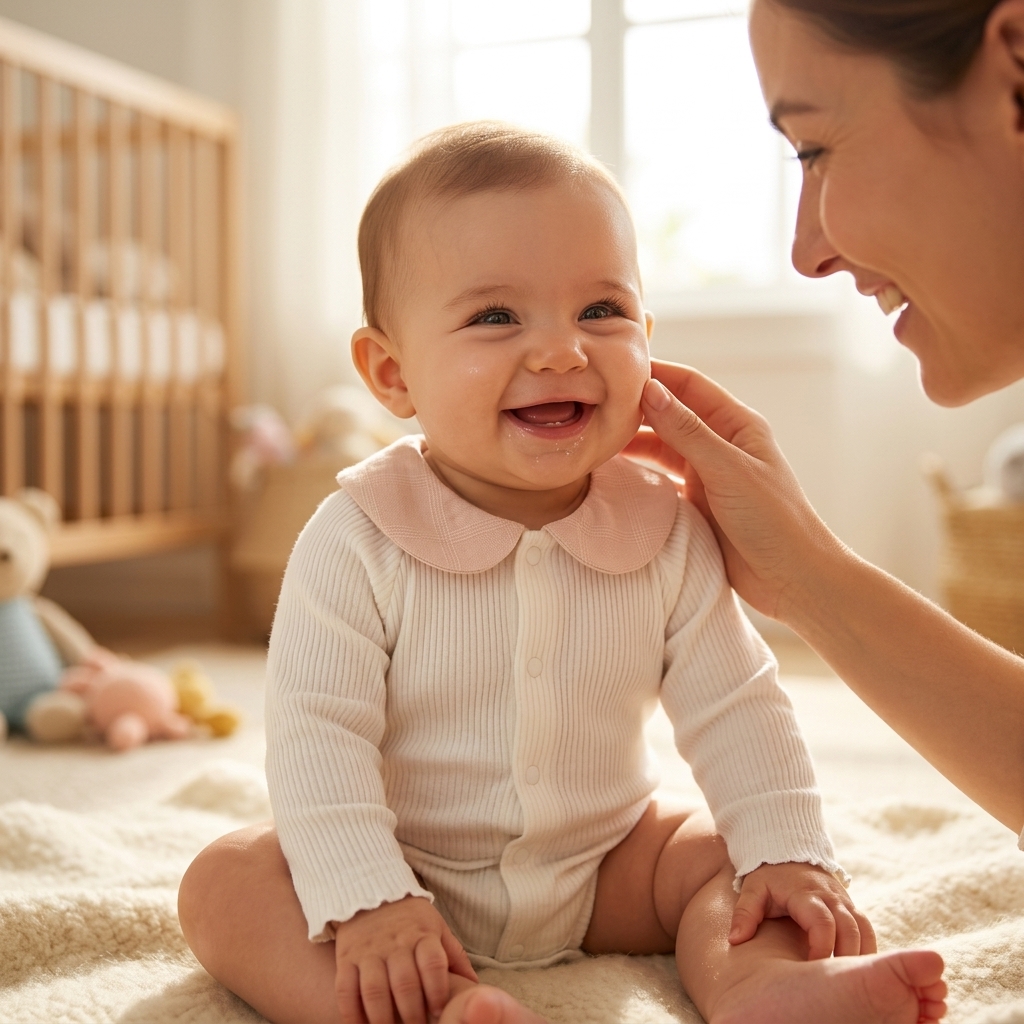
The Science Behind the Social Smile
The social smile reflects a specific developmental transition in the brain. In the first weeks of life, the cerebral cortex — the region responsible for conscious, social processing — is not yet fully engaged in regulating behavior. Social smiling appears when cortical connections mature enough to process and respond to social stimuli intentionally.
This is why the social smile arrives on a relatively predictable schedule regardless of how much face time baby has had: it's a neurological milestone, not a learned behavior. However, babies who receive more responsive interaction tend to smile more frequently once they begin — the social smile is the first step in a feedback loop of connection and development.
Smiling as Communication: What It Means for Development
The social smile is far more than an adorable expression. It marks the beginning of intentional social communication — baby's first way of expressing pleasure and initiating connection with another person. It's the foundation for everything that follows in social development:
- Laughing (typically follows smiling by 4–6 weeks — see our guide on when babies start laughing)
- Making eye contact intentionally
- Responding to names (around 6–8 months)
- Social referencing — checking a caregiver's expression for cues about how to respond to something new
Research consistently shows that serve-and-return interaction — where a caregiver responds to baby's smile or vocalization, and baby responds in turn — is one of the most powerful drivers of brain development in the first year. Each smiling exchange is quite literally building neural architecture.
Premature Babies and Smiling
For premature babies, the expected timeline shifts. Social smiling in premature babies is typically assessed based on corrected age (gestational age) rather than chronological age. A baby born 6 weeks early would be expected to smile around 6–8 weeks corrected, not 6–8 weeks from birth. This applies to most developmental milestones through the first two years.
When to Speak to a Pediatrician
Mention to your pediatrician if your baby has not produced any social smiles by 3 months (or 3 months corrected for premature babies). Absence of social smiling by this point can be an early indicator of developmental differences that benefit from early assessment and, if needed, early intervention. Most pediatricians screen for this at the 2-month well visit.
For the complete picture of what's developing alongside the first smile, see our guides on 3-month-old milestones and baby milestones by week.
How to Encourage Smiling
- Talk to baby constantly: Narrate what you're doing, describe what you see, sing. Consistent verbal interaction during alert windows is the single most effective way to stimulate social responsiveness.
- Prioritize face-to-face time: Carriers that face baby inward, nursing, floor time with eye contact — these create the close-face-to-face opportunities that trigger smiling most reliably.
- Respond to every smile: When baby smiles, smile back. This reinforces the connection and teaches baby that their expressions produce responses — the foundation of communication.
- Choose the right moment: Alert but calm, after a feed, not overtired. You'll learn your baby's windows quickly.
Dressing Baby for Face-to-Face Time
The best outfits for interactive alert time are comfortable, non-restrictive, and easy to change quickly when the session ends with a diaper. Soft bodysuits with delicate collar details work beautifully for this stage — comfortable enough for extended floor time, sweet enough for the photos you'll inevitably take when that first smile finally arrives. Browse the Mimou baby girl collection or our full baby onesie guide for the best options by age.