


"Newborn sleep schedule" is a phrase that promises more order than the first weeks of parenthood actually deliver. Newborns don't follow schedules — they follow biological rhythms that are, at first, completely disconnected from the 24-hour day. The goal in the early weeks isn't to impose a schedule but to understand those rhythms, respond to them, and lay the foundation for better sleep to emerge naturally around 3–4 months. Here's how it actually works.
Why Newborns Don't Sleep Through the Night
This isn't a parenting failure — it's biology. Newborns have three structural sleep features that make night waking inevitable:
- Stomach size: A newborn's stomach holds approximately 1–3 oz. It empties in 1.5–3 hours. Biologically, they must wake to feed frequently — there's no way around this in the early weeks.
- No circadian rhythm: The circadian rhythm (the internal clock that distinguishes day from night) is not present at birth. It develops between 6 and 12 weeks as melatonin production matures. Until it does, newborns genuinely cannot distinguish 2pm from 2am.
- High proportion of REM sleep: Newborns spend approximately 50% of their sleep in active REM sleep (adults spend about 20%). REM sleep is lighter and more easily interrupted, which means newborns wake more frequently between sleep cycles than older babies do.
Newborn Sleep by Age: What to Expect
| Age | Total Sleep | Night Sleep | Naps | Wake Windows |
|---|---|---|---|---|
| 0–2 weeks | 16–18 hrs | 8–9 hrs (interrupted) | 7–8 naps | 45–60 min |
| 2–6 weeks | 15–17 hrs | 8–9 hrs (interrupted) | 5–7 naps | 45–75 min |
| 6–12 weeks | 14–16 hrs | 9–10 hrs (interrupted) | 4–5 naps | 60–90 min |
| 3–4 months | 14–16 hrs | 10–11 hrs (with 1–3 wakes) | 3–4 naps | 90 min–2 hrs |
The Wake Window: The Most Useful Concept for New Parents
A wake window is the amount of time a baby of a given age can comfortably stay awake before becoming overtired. Overtired babies paradoxically have more difficulty falling asleep and staying asleep — a counterintuitive fact that trips up many parents.
For newborns 0–6 weeks, the wake window is just 45–60 minutes. This means baby should be heading toward sleep within an hour of waking — including feeding time. If you're watching for tired cues (yawning, turning away from stimulation, eye rubbing) and responding to them before baby becomes overstimulated, sleep is usually much easier to achieve.
Safe Sleep: The Non-Negotiables
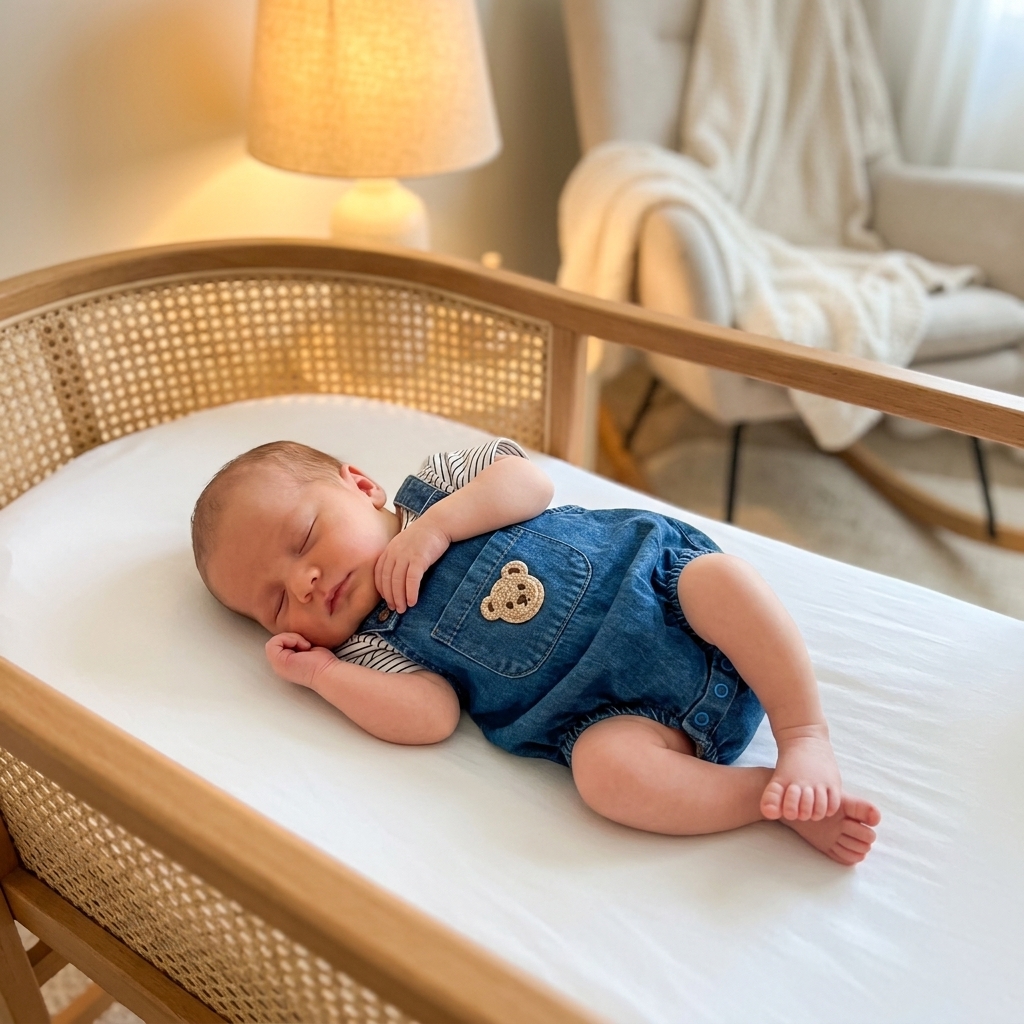
Every sleep environment, every time, must meet AAP safe sleep guidelines:
- Back to sleep: Baby sleeps on their back for every sleep until they can roll independently in both directions
- Firm, flat surface: A firm crib or bassinet mattress with a tight-fitting sheet. No inclined sleepers, bouncers, swings, or car seats for routine sleep
- Bare sleep environment: No loose blankets, pillows, bumpers, positioners, or stuffed animals in the sleep space
- Room-sharing, not bed-sharing: Baby sleeps in their own space in the parents' room for at least the first 6 months per AAP guidance
- Temperature 68–72°F: Baby should feel warm but not hot at the back of the neck. A single sleep layer (onesie + sleep sack appropriate for room temperature) is usually sufficient
For choosing the right sleep clothing, see our baby pajamas and safe sleep guide and our sleep sack guide.
How to Encourage a Longer First Nighttime Stretch
You can't force sleep consolidation before the biology is ready. But you can create conditions that make it more likely:
- Maximize daytime light exposure: Natural light is the primary signal that sets the circadian clock. Bright, active daytime environments and dim, quiet nighttime environments accelerate the development of day/night differentiation.
- Full feeds during the day: Dream feeds and cluster feeding in the evening can shift more caloric intake to daytime hours, reducing the biological need for nighttime feeds earlier.
- Swaddle for overnight sleep: A well-executed swaddle suppresses the Moro reflex that wakes babies between sleep cycles. See our complete guide on how to swaddle a baby.
- White noise: Consistent white noise at moderate volume (around 65 dB, no louder) masks household sounds that would otherwise trigger waking.
- Consistent pre-sleep routine: Even at 4–6 weeks, a simple 10–15 minute routine (feed, dim lights, swaddle, brief rocking, down awake-but-drowsy) begins to create sleep associations that make settling faster over time.
For the full picture of when sleep begins to consolidate, see our guide on when babies sleep through the night.