


"When will my baby sleep through the night?" is the question most new parents ask more often than any other. The honest answer is more nuanced than most baby books suggest — because "sleeping through the night" means different things at different ages, and the timeline is driven by biology, not by anything parents are or aren't doing. Here's the complete, evidence-based picture.
What "Sleeping Through the Night" Actually Means
In sleep research, "sleeping through the night" is defined as sleeping for a continuous stretch of 5–6 hours. That's the clinical definition — not 8 hours, not 12. Most parents are working with a different expectation, which is part of why the milestone feels so elusive.
In practice, what parents mean is "sleeping long enough that I feel rested." That threshold is different for every family, which is why conversations about this milestone are so often frustrating: people are comparing numbers that mean different things.
When Do Most Babies Sleep Through the Night?
| Age | Realistic Expectation | % of Babies |
|---|---|---|
| 0–3 months | Multiple night wakes; 2–3 hour stretches | Universal |
| 3–4 months | 1–2 night feeds; 4–6 hour stretches possible | ~50% achieve 5hr stretch |
| 4–6 months | 1 night feed; 6–8 hour stretches | ~70% sleeping 6hr+ stretch |
| 6 months | Many ready to night-wean with guidance; 8hr+ stretches | ~80% can sleep 8hr+ |
| 9–12 months | Most babies biologically capable of 10–12 hour nights | ~90%+ biologically capable |
A critical note on that last column: "biologically capable" doesn't mean "actually doing it." Sleep habits, sleep associations, and individual variation mean many babies who are biologically capable of sleeping through the night don't do so without some form of sleep training or gradual intervention.
The 4-Month Sleep Regression
Around 3–4 months, many parents experience a brutal disruption: a baby who was beginning to consolidate sleep suddenly wakes more frequently than they did in the newborn stage. This is the 4-month sleep regression, and it's not a regression at all — it's a permanent change in sleep architecture.
At around 3–4 months, baby's sleep cycles shift from newborn patterns (primarily deep sleep and active REM) toward more adult-like cycles with distinct light and deep phases. Babies who have learned to fall asleep only with assistance (feeding, rocking, holding) now wake at the end of each light phase cycle and need that same assistance to return to sleep. Babies who have developed some self-settling ability can link cycles independently.
This is why the 4-month mark is often when parents first seriously consider sleep training — and why it's also the earliest age at which most pediatric sleep experts consider it appropriate.
What Helps Babies Sleep Longer Stretches
Before 4 Months (Biological Foundation)
- Maximize daytime light: Natural bright light during the day accelerates circadian rhythm development, the biological prerequisite for night sleep consolidation
- Swaddle for overnight sleep: Suppresses the Moro reflex that wakes sleeping babies between sleep cycles. See our complete swaddling guide
- Consistent pre-sleep routine: Even a simple 10-minute wind-down sequence begins building sleep associations
- Responsive settling: Responding quickly to cues prevents overtiredness, which paradoxically makes sleep worse
From 4 Months Onward (Sleep Training if Needed)
- Graduated extinction ("Ferber"): Check-and-console method with progressively longer intervals between visits. Strong evidence base for effectiveness and safety
- Full extinction ("cry it out"): No check-ins after bedtime. Fastest results; most difficult for parents emotionally. Also has strong evidence for safety and effectiveness
- Chair method ("Sleep Lady Shuffle"): Parent sits progressively further from crib over days to weeks. Slower but emotionally easier for many parents
- Fading: Gradually reduce the level of assistance at each sleep onset over 1–2 weeks
All evidence-based sleep training methods, when applied appropriately from around 4 months, show no evidence of long-term harm to babies and significant improvement in parental sleep and wellbeing.
What Does Not Make Babies Sleep Through the Night Earlier
- Introducing solids early: No evidence that introducing solid foods before 6 months improves night sleep. The caloric density of solids doesn't significantly differ from formula or breast milk at these volumes
- Keeping baby awake longer during the day: Overtired babies sleep worse, not better. This approach reliably backfires
- Formula vs. breast milk: No significant difference in sleep duration between formula-fed and breastfed babies in controlled studies
Safe Sleep First, Always
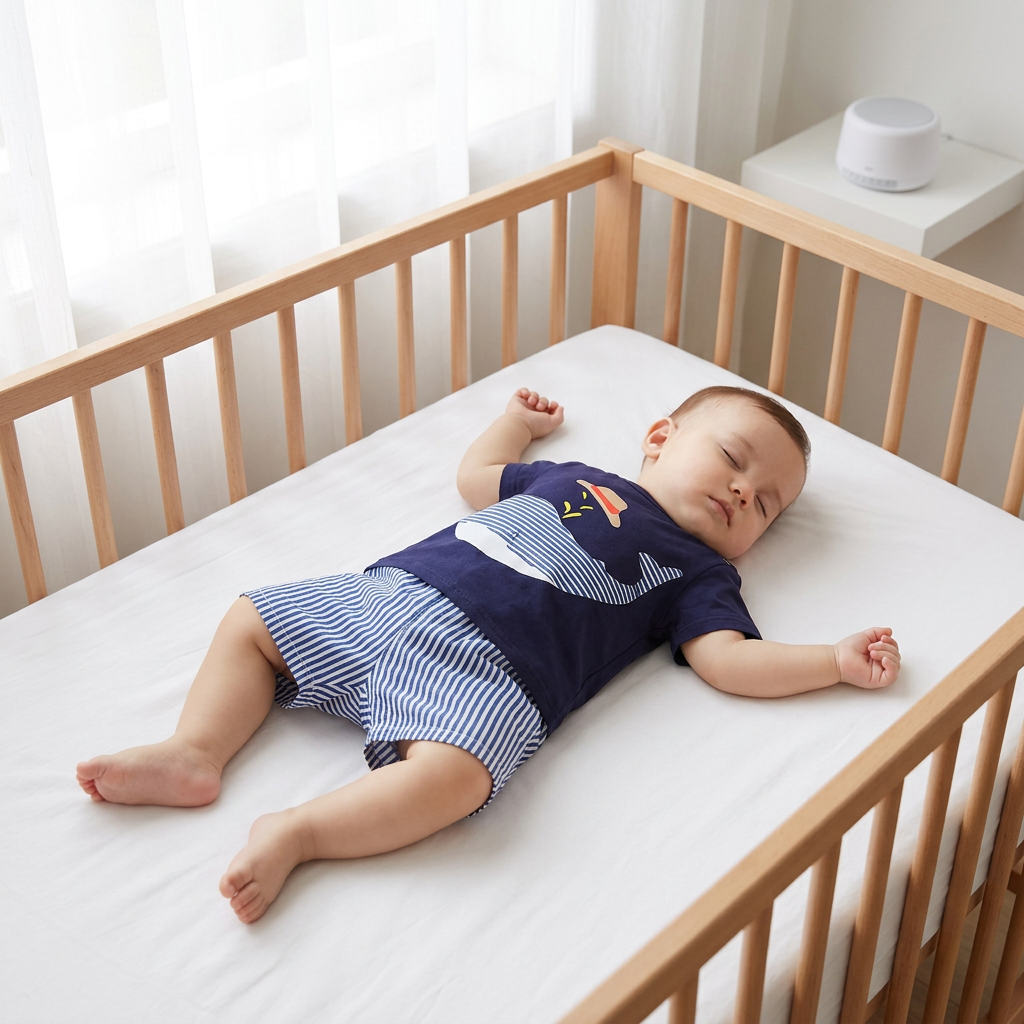
Whatever the approach to sleep, safe sleep guidelines apply at every age: back to sleep on a firm flat surface, bare sleep environment, appropriate room temperature. For full guidance see our safe sleep guide and our newborn sleep schedule guide. For the right sleep clothing at every stage, see our sleep sack guide.